

Herz P1 Smart BPM Under Investigation: Clinical-Grade Blood Pressure Monitoring for Valuable At-Home Health Tracking Support
A 2026 informational overview of Herz P1 Smart BPM FDA 510K clearance, wrist blood pressure monitor accuracy considerations, irregular heartbeat detection features, at-home cardiovascular tracking awareness, and key product details for health-conscious adults
Akron, OH, April 20, 2026 (GLOBE NEWSWIRE) -- This informational overview contains affiliate links. If a purchase is made through these links, a commission may be earned at no additional cost to the buyer. This overview is intended for general awareness purposes only and does not constitute medical, health, or diagnostic guidance. All product details described below are as the company presents them as published on the official product page and should be verified directly.
This informational release is intended to provide a structured overview of the Herz P1 Smart BPM and highlight key considerations around at-home blood pressure monitoring. The term "under investigation" in this context reflects ongoing consumer interest in understanding device features, usability, and general cardiovascular tracking practices — not a third-party audit or regulatory proceeding. The term "clinical-grade" reflects language used in the company's own marketing materials, described within the scope of the device's regulatory classification.
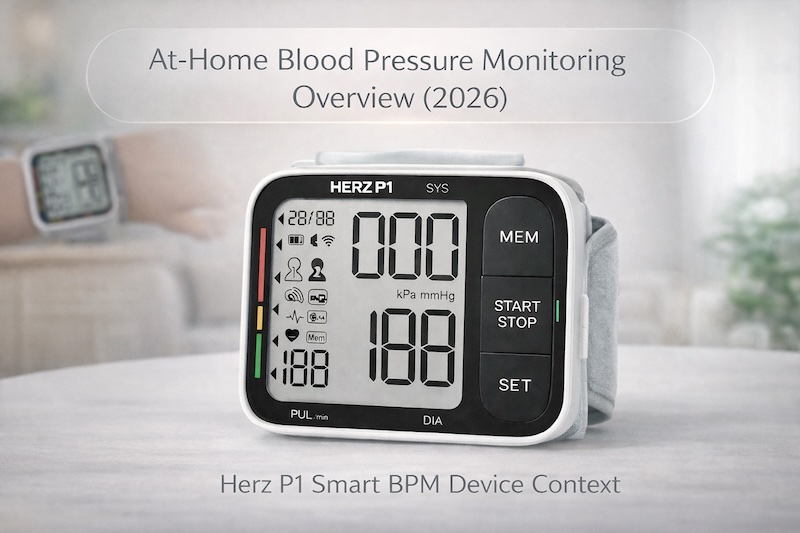
For individuals researching wrist blood pressure monitors that do not require app connectivity or subscriptions, the Herz P1 Smart BPM is increasingly visible in consumer searches related to at-home blood pressure monitoring. The device appears frequently in search results related to at-home cardiovascular monitoring, particularly among adults over 40 who want to track cardiovascular health without the complexity that most modern health wearables introduce.
Increased consumer interest has led to common questions about device features, regulatory context, and at-home monitoring considerations. What does FDA 510K clearance actually cover for a wrist monitor? How does the irregular heartbeat detection feature work, and what are its limitations? Is a wrist-based device accurate enough for meaningful daily tracking? And how are pricing and guarantee terms presented across the product page?
This overview is based on product information presented by Herz P1 Smart BPM including in the product materials and general publicly available guidance on blood pressure monitoring.
Current product details, pricing, and terms can be confirmed by viewing the current Herz P1 Smart BPM offer (official Herz P1 page).
Individual results vary. Blood pressure monitoring devices are not substitutes for professional medical diagnosis or treatment. Consult a qualified healthcare provider before making changes to any cardiovascular health management plan based on readings from any home monitoring device.
What Is the Herz P1 Smart BPM
The Herz P1 Smart BPM is a wrist-worn blood pressure monitoring device from Herz P1 LLC, based in Akron, Ohio. The device is intended for routine at-home use and measures systolic pressure, diastolic pressure, and heart rate in a single reading that completes in approximately 30 to 45 seconds.
The product page lists the following regulatory certifications: FDA 510K, CE MDR, ISO 13485, ISO 14001, TGA, IEC, and CFDA. These certifications relate to accuracy, safety, and manufacturing quality standards within their respective regulatory frameworks.
Unlike many modern health devices, the Herz P1 Smart BPM operates as a fully self-contained unit. There is no Bluetooth, no companion app, no Wi-Fi requirement, and no subscription fee. All readings are stored and displayed directly on the device itself. This is positioned as a deliberate design choice aimed at users who want simplicity over connectivity — particularly older adults and individuals with limited technology comfort.
The device runs on two standard AAA batteries, which are included in the box. With typical twice-daily use, batteries last several months before needing replacement.
Understanding FDA 510K Clearance: What It Covers
The Herz P1 Smart BPM prominently features FDA 510K clearance in its product listing. For anyone comparing this device against other options, understanding what this designation specifically means — and what it does not — is one of the most useful things to research.
FDA 510(k) clearance is a premarket notification process. A 510(k) submission demonstrates that a device is substantially equivalent to a legally marketed predicate device already on the market. The FDA reviews the submission and, if it agrees the device is substantially equivalent, clears it for commercial distribution.
What this means in practice: the Herz P1 Smart BPM has been reviewed by the FDA and determined to be substantially equivalent in intended use and technological characteristics to an existing legally marketed device. The manufacturer submitted performance data supporting this determination.
What 510(k) clearance does not mean: it is not the same as FDA "approval" in the way that term applies to pharmaceutical drugs or Class III medical devices such as pacemakers. The 510(k) process is based on the manufacturer's submitted data demonstrating substantial equivalence. Consumers interested in the specific clearance details can search the FDA's publicly accessible 510(k) database using the product or manufacturer name.
The additional certifications listed — CE MDR, ISO 13485, ISO 14001, TGA, IEC, CFDA — relate to European Union medical device regulations, quality management systems, environmental management, Australian therapeutic goods standards, international electrotechnical standards, and Chinese regulatory clearance, respectively. Each has its own scope and requirements.
Wrist Monitor Accuracy: Key Considerations for the Category
One of the most common questions people research when considering any wrist blood pressure monitor is accuracy compared to traditional upper-arm cuff devices. This is a legitimate concern grounded in published clinical guidance, and it is worth understanding before evaluating the Herz P1 specifically.
Published clinical guidance from organizations including the American Heart Association has historically noted that wrist blood pressure monitors can be accurate but are more sensitive to body position during measurement than upper-arm devices. Wrist monitors may produce less reliable readings if the wrist is not positioned precisely at heart level during measurement. Upper-arm monitors are generally preferred for clinical use, though wrist devices may be appropriate for individuals who find arm cuffs uncomfortable or difficult to use.
The Herz P1 Smart BPM includes two features intended to support measurement consistency. First, a cuff self-checking function that verifies proper cuff fit before completing a reading. Second, a movement error detection system that flags a compromised reading and prompts the user to retake the measurement rather than displaying an unreliable number.
Whether these features fully resolve the accuracy considerations associated with wrist-based measurement depends on factors including individual physiology, positioning consistency, and environmental conditions during measurement. Individuals whose readings will inform clinical conversations — such as medication titration — should discuss their choice of home monitoring device with a prescribing physician.
Irregular Heartbeat Detection: Capabilities and Limitations
The Herz P1 Smart BPM includes an automatic irregular heartbeat indicator that may flag potential pulse irregularities during measurement. This feature activates during every blood pressure reading and displays a visual alert on the screen when a pulse pattern outside of normal rhythm is identified.
This is an important feature to understand correctly. The product FAQ describes the irregular heartbeat alert as "a flag to show a doctor — not a diagnosis." That distinction matters significantly.
Irregular heartbeat indicators in consumer blood pressure monitors detect pulse irregularities during oscillometric measurement. They are not equivalent to an electrocardiogram (ECG or EKG), which measures the heart's electrical activity and is the clinical standard for diagnosing conditions such as atrial fibrillation, arrhythmia, and other cardiac rhythm disorders.
What the irregular heartbeat indicator is intended to do: alert users to pulse irregularities that may warrant further clinical evaluation. For individuals who measure daily, this creates a longitudinal record that a cardiologist or primary care physician can review alongside clinical testing.
What it is not intended to do: diagnose atrial fibrillation or any specific cardiac condition. It does not replace an ECG, Holter monitor, or other clinical cardiac monitoring equipment. A single irregular heartbeat flag — or the absence of one — should not be the basis for any medical decision without professional consultation.
Individuals managing a known cardiac condition such as AFib should consult a cardiologist about whether a consumer-grade irregular heartbeat indicator provides clinically useful supplementary data for their specific situation.
Key Device Specifications
The Herz P1 Smart BPM product listing includes the following specifications:
Display: 51 mm × 46.68 mm (approximately 2" × 1.8") LCD screen. The display simultaneously shows systolic pressure, diastolic pressure, heart rate, and irregular heartbeat status. The screen is described as readable without reading glasses in various lighting conditions.
Memory: 240 total readings stored across two separate user profiles (120 readings per user). This supports approximately 60 days of twice-daily measurements per user, and the dual-profile system prevents data crossover between users.
Cuff Size: Adjustable wrist cuff fitting 13.5 cm to 21.5 cm (approximately 5.3" to 7.7"). This covers the large majority of adult wrist sizes. Wrist measurements outside this range should be confirmed before ordering.
Power: Two 1.5V AAA alkaline batteries, pre-included in the box. No charging cables, USB connections, or external power sources required.
Reading Time: Readings complete in approximately 30 to 45 seconds after pressing the start button.
Connectivity: None. No Bluetooth, Wi-Fi, NFC, or app integration. All data is stored and accessed directly on the device.
Specifications are presented as published on the product page. Verify current specifications directly, as manufacturers may update product details.
Who the Herz P1 Smart BPM May Be Right For
The Herz P1 Smart BPM May Align Well With People Who:
Want daily cardiovascular monitoring without digital complexity. The single-button operation and zero-connectivity design make this device accessible to users who find app-dependent devices frustrating or unusable. For individuals whose ideal monitoring experience is "put it on, press a button, read the screen," this device is aligned with that type of usage pattern.
Find traditional arm cuffs uncomfortable or difficult to use. Individuals with limited upper-arm dexterity, arthritis, or sensitivity to arm-cuff compression may find a wrist-based design more practical for consistent daily use. Consistency of use matters more for longitudinal tracking than any single reading.
Need to share a device between two people. The dual-user memory system with 120 readings per profile supports couples, caregiver situations, or households where two people need separate cardiovascular tracking from one device. Readings are stored in completely separate memory banks.
Want to bring organized data to medical appointments. Accumulating 30 to 60 days of twice-daily readings can create a dataset that healthcare providers can review for patterns, trends, and medication response — something a single in-office reading cannot provide.
Other Options May Be Preferable For People Who:
Need ECG-level cardiac monitoring. The irregular heartbeat indicator is a screening flag, not a diagnostic tool. Individuals whose cardiologist requires ECG-grade rhythm data may find a dedicated ECG device or medical-grade monitor more appropriate.
Prefer connected devices that sync with health apps. Anyone seeking automatic cloud backup, trend charts on a phone, or integration with platforms like Apple Health or Google Fit should note that the Herz P1 does not offer these capabilities by design.
Require upper-arm measurement for clinical precision. Individuals whose physician has specifically recommended an upper-arm blood pressure monitor for clinical purposes such as medication adjustment should note that a wrist device — regardless of brand — may not meet those requirements.
Questions Worth Considering
Before choosing any home blood pressure monitor, consider the following:
Has a physician expressed a preference for arm-cuff or wrist-based monitoring?
Is an arm-cuff monitor realistically going to be used daily, or does discomfort or inconvenience reduce the likelihood of consistent measurement?
Is app connectivity important, or would a self-contained device better match daily routine needs?
Will the device be shared between two people in the same household?
These answers help determine which blood pressure monitor characteristics matter most for a given situation.
Pricing and Availability
The Herz P1 Smart BPM is listed as a one-time purchase. At the time of this overview, the product page features a promotional offer described as "Save 60%" with the device listed at $59.99. Delivery is described as within 2 to 3 business days.
The purchase includes the Herz P1 Smart BPM device, two AAA batteries, a quick-start guide, and what is described as a free Heart Health Tracking Kit including a Doctor-Ready Report template.
Pricing and promotional terms may change without notice. Verify current pricing and terms on the official product page.
Guarantee and Return Policy
The product page references two different guarantee timeframes in different locations. The main promotional sections reference a "90 Days Money Back Guarantee," while the FAQ section references a "30-day no-questions-asked money-back guarantee." This discrepancy is worth clarifying directly with customer support before ordering.
Reviewing the complete return policy terms — including any conditions regarding product condition, return shipping responsibilities, and refund processing timelines — on the official website before ordering is recommended. Retaining all purchase confirmation details and order numbers is advised regardless of the applicable guarantee period.
Customer Feedback Context
The product page references "5,000+ 5-Star Reviews" and includes customer feedback presented within the company's own website environment. The website footer includes a disclosure stating that the site "is an advertisement and not an actual news article, blog, or consumer protection update" and that results are based on individual experiences and may not be typical. Individual experiences vary.
Consumer Questions About the Herz P1 Smart BPM
What does FDA 510K clearance mean for this device?
FDA 510(k) clearance is a premarket notification process — not "approval" in the way that term applies to drugs or Class III medical devices. It means the FDA has determined the device is substantially equivalent to a legally marketed predicate device based on the manufacturer's submitted data. The clearance can be verified in the FDA's public database.
How accurate is a wrist blood pressure monitor compared to an arm cuff?
Published clinical guidance notes that wrist monitors can provide accurate readings but are more sensitive to body positioning than arm-cuff devices. The Herz P1 includes cuff self-checking and movement error detection features intended to support measurement consistency. For clinical purposes, discussing which monitor type is appropriate with a physician is recommended.
Can the irregular heartbeat feature detect atrial fibrillation?
The irregular heartbeat indicator is intended to flag pulse irregularities during blood pressure measurement. It is described as "a flag to show a doctor — not a diagnosis." It is not an ECG and is not intended to diagnose AFib or any specific cardiac condition. Flagged readings should be discussed with a cardiologist for proper evaluation.
Does the device require a smartphone or app?
No. The Herz P1 Smart BPM is fully self-contained. All readings are stored and displayed on the device. There is no Bluetooth, no app, and no subscription fee.
Can two people share one device?
Yes. The device includes dual-user memory with 120 readings per user stored in separate memory banks, suitable for couples or caregiver monitoring situations.
What does the purchase include?
The product page lists the Herz P1 Smart BPM device, two AAA batteries, a quick-start guide, and a Heart Health Tracking Kit with a Doctor-Ready Report template.
Is the guarantee 90 days or 30 days?
The product page shows both "90 Days Money Back Guarantee" in promotional sections and "30-day no-questions-asked money-back guarantee" in the FAQ section. Confirming the applicable guarantee period directly with customer support before ordering is recommended.
How long does delivery take?
The main product page describes delivery in 2 to 3 business days. The FAQ section lists 3 to 5 business days. Confirming current shipping timelines when ordering is advisable.
Is the Herz P1 Smart BPM suitable for seniors?
The device is presented as suitable for users seeking simplified, non-connected monitoring, with single-button operation, a large LCD display, and no digital setup requirements. Individuals with specific dexterity or vision concerns may want to review the device specifications to confirm compatibility with their needs.
Additional Reading
For broader context on the Herz P1 product line, a 2026 overview of the Herz P1 Smart Oximeter and pulse oxygen monitoring features covers the brand's broader device range. A separate Herz P1 product line overview provides additional context on the company's positioning across multiple product categories.
Reviewing multiple sources when researching health monitoring devices is always recommended. The FDA's general guidance on home blood pressure monitors and the American Heart Association's published recommendations for at-home blood pressure monitoring are both publicly available.
Summary
The Herz P1 Smart BPM is a wrist-mounted blood pressure monitor built around simplicity, accessibility, and independence from digital ecosystems. The device includes features such as irregular heartbeat detection, dual-user memory, a large LCD display, and single-button operation — all without requiring a smartphone, app, or subscription.
The device carries FDA 510K clearance along with multiple international regulatory certifications. FDA 510(k) clearance confirms the manufacturer has demonstrated substantial equivalence to a legally marketed predicate device through the FDA's premarket notification process.
The irregular heartbeat indicator is intended to flag pulse irregularities for further medical evaluation — it is not intended to diagnose cardiac conditions. Published clinical guidance on wrist blood pressure monitors generally notes they can be accurate but are more position-sensitive than arm-cuff devices. The Herz P1 includes cuff self-checking and movement error detection features intended to support measurement consistency.
Contact Information
For questions before or during the ordering process, Herz P1 offers customer support through the following channels:
Company: Herz P1 LLC
Address: 839 E Market St, Ste 106 #165, Akron, OH 44305, United States
Email: support@herzp1.com

Phone: (877) 309-3614
Phone Support Hours: 9:00 AM to 5:00 PM Eastern, Monday through Friday
SMS Support: +1 (888) 256-4198
Disclaimers
Content and Consumer Information Disclaimer: This overview is intended for general awareness purposes only and does not constitute medical, health, diagnostic, or purchasing guidance. All product details, specifications, pricing, and policy terms described are presented as published on the official product page and product listing. Readers are encouraged to verify all claims directly with the manufacturer and to consult a qualified healthcare professional before relying on any home monitoring device for health management decisions.
Medical Device and Health Notice: Blood pressure monitors, including wrist-based devices, are measurement tools — not diagnostic instruments. Readings from any home blood pressure monitor should be interpreted in consultation with a qualified healthcare provider. Do not adjust, start, or discontinue any medication or treatment based solely on readings from a consumer blood pressure monitor. The irregular heartbeat indicator is a screening feature that flags pulse irregularities; it is not intended to diagnose atrial fibrillation, arrhythmia, or any cardiac condition. Always consult a cardiologist or physician for cardiac concerns.
Regulatory Clearance Context: The Herz P1 Smart BPM carries FDA 510K clearance. FDA 510(k) clearance is a premarket notification process that determines substantial equivalence to a predicate device. It does not constitute FDA approval in the regulatory sense applied to drugs or Class III medical devices. Additional certifications listed (CE MDR, ISO 13485, ISO 14001, TGA, IEC, CFDA) each have their own regulatory scope.
Results, Accuracy, and Individual Variability: Blood pressure readings vary based on factors including body position, time of day, recent physical activity, caffeine or medication intake, stress levels, ambient temperature, and individual physiology. Wrist-based monitors are generally considered more position-sensitive than upper-arm devices. Accuracy of any individual reading depends on proper device positioning and usage technique. No home blood pressure monitor guarantees identical readings to equipment used in a physician's office.
FTC Affiliate Disclosure: This overview contains affiliate links. If a product is purchased through these links, a commission may be earned at no additional cost to the buyer. This compensation does not influence the accuracy, neutrality, or integrity of the information presented. All descriptions are based on publicly available information from the official product page and general clinical context.
Pricing Disclaimer: All prices, promotional offers, and guarantee terms mentioned were based on information published on the official product page at the time of publication (April 2026) and are subject to change without notice. The product page displays both "90 Days Money Back Guarantee" and "30-day no-questions-asked money-back guarantee" in different sections. Always verify current pricing, guarantee period, and return terms directly on the official website before making a purchase.
Publisher Responsibility Disclaimer: Every effort has been made to ensure accuracy at the time of publication. Responsibility is not accepted for errors, omissions, or outcomes resulting from the use of the information provided. Readers are encouraged to verify all details directly with Herz P1 LLC and their healthcare provider before making decisions.

Email: support@herzp1.com Phone: (877) 309-3614 Phone Support Hours: 9:00 AM to 5:00 PM Eastern, Monday through Friday SMS Support: +1 (888) 256-4198

Legal Disclaimer:
EIN Presswire provides this news content "as is" without warranty of any kind. We do not accept any responsibility or liability for the accuracy, content, images, videos, licenses, completeness, legality, or reliability of the information contained in this article. If you have any complaints or copyright issues related to this article, kindly contact the author above.
